Websites are easy to think of as weightless.
They sit somewhere in “the cloud”, people visit them, pages load, tickets are sold and content is shared. But every one of those actions uses energy. Websites need hosting, data needs to travel across networks and every visitor uses a device to access what you publish.
That does not mean arts organisations should strip their websites back to a few lines of text and stop using images, video or interactive features.
The more useful question is:
How can we create the greatest possible impact while using digital resources responsibly?
That was the focus of our recent webinar, Balancing your website’s impact and sustainability, hosted by Hans de Kretser with HDK Web Project Manager Ece Firat and Web Support Developer Joseph Berry.
The session explored where a website’s environmental impact comes from, how to balance sustainability with audience experience, and which practical improvements organisations can make now.
At the beginning we asked the nearly 100 arts professionals who attended how many knew the carbon footprint of their website. Only 20% said they actively measured sustainability across their organisation. The largest group, 40%, said sustainability mattered to them, but they were not yet measuring the impact of their website.
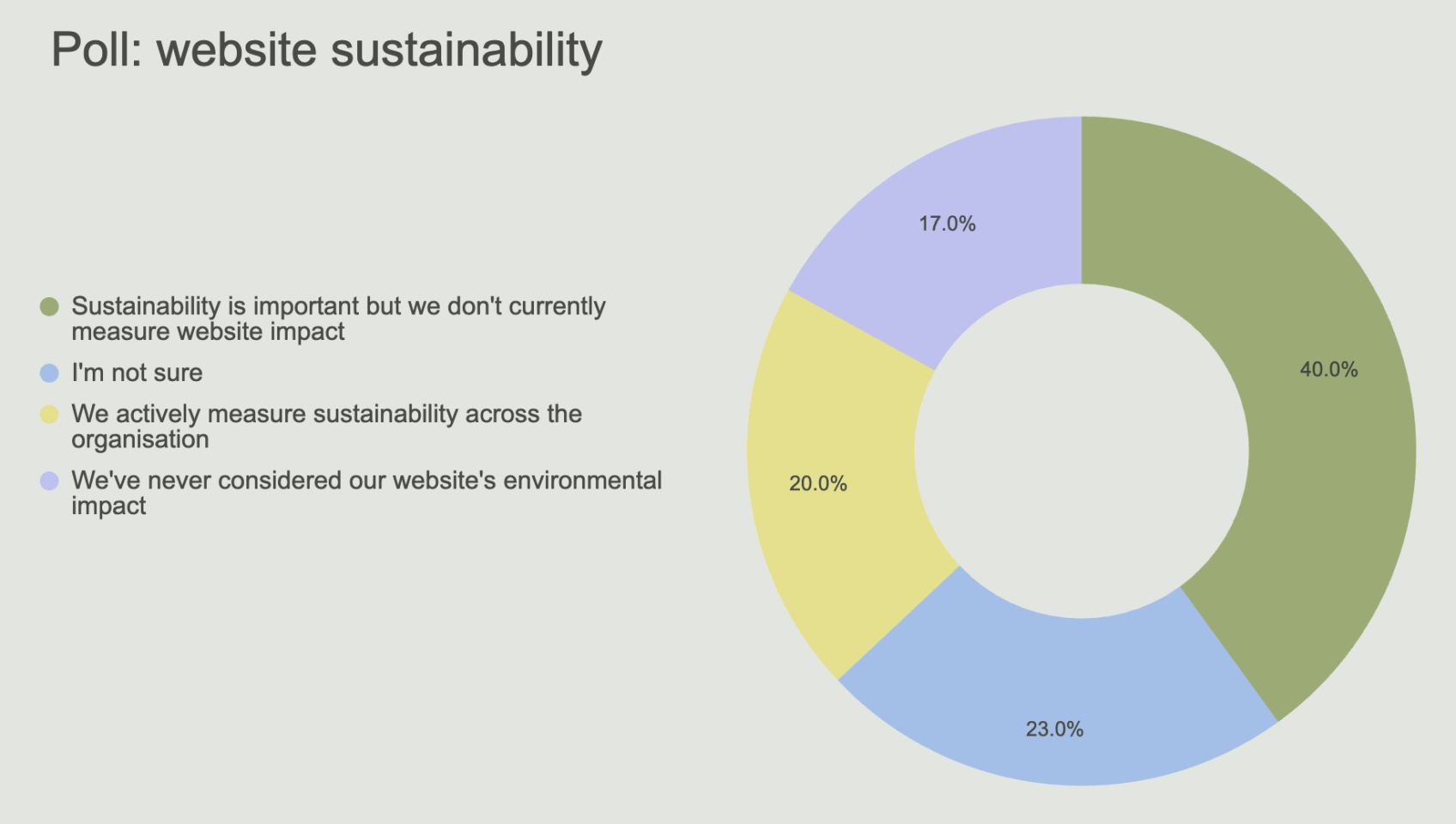
Another questions we asked during the webinar was:
What contributes most to a website’s environmental impact?
Hosting? Images? Video? Website traffic? Design features? The slightly frustrating answer is that it depends.
A theatre website with a large homepage video may have a very different footprint from a museum website containing thousands of collection images. A relatively simple festival website might use fewer resources per visit, but receive a huge spike in traffic when tickets go on sale.
This is why carbon scores and benchmarking tools can be useful, but they do not tell the whole story.
The aim is not simply to identify the “worst” element of a website. It is to understand where the biggest opportunities for improvement lie.
Small decisions add up when repeated thousands of times:
- every image
- every video
- every script
- every visitor
Measure your website
If you’d like to understand how your website is performing today, these free tools are a great place to start:
Website Carbon Calculator
A quick way to estimate the carbon footprint of individual web pages and benchmark them against other websites.
Go to: Website Carbon Calculator
Google PageSpeed Insights
Measures page speed and Core Web Vitals, while highlighting opportunities to improve performance. Many of the recommendations also support sustainability by reducing unnecessary data transfer.
Go to: Google PageSpeed Insights
Ecograder
Provides a broader sustainability assessment, looking at factors such as page weight, hosting, caching and optimisation, along with practical recommendations.
Remember that these tools provide estimates rather than definitive measurements. They are most useful for identifying opportunities for improvement and tracking progress over time, rather than chasing a perfect score.
Sustainability does not have to mean saying no
A recurring theme in the webinar was that sustainability is not about automatically removing anything visually ambitious or technically complex.
Arts and cultural websites need to inspire people. Photography, film, digital collections and rich storytelling can all help audiences connect with an organisation and decide to visit, participate, donate or book. The question is whether each element earns its place.
A homepage video may be entirely justified if it communicates something important and supports audience engagement. But it should still be compressed, delivered efficiently and prevented from loading unnecessarily.
Similarly, a museum may need to provide high-resolution archive images. The sustainable response is not necessarily to remove them, but to find the most efficient way to deliver them.
This came through clearly in the audience questions. Attendees asked about YouTube embeds, image delivery through IIIF, deferred carousel images and the impact of old files sitting in a website’s media library.
There is rarely a universal yes-or-no answer. The best decision depends on purpose, implementation and scale.
Good website housekeeping matters
A more sustainable website is often simply a better-maintained website.
During the session, Ece and Joseph shared several areas worth reviewing:
Optimise images
Images are often among the heaviest elements on a page. Using appropriate dimensions, modern formats and automated compression can make a substantial difference without visibly reducing quality.
Review outdated code and tracking
Websites accumulate plugins, integrations, marketing pixels and features over time. Some continue to load long after anyone has stopped using them.
Removing unnecessary code can improve sustainability, performance, privacy and security at the same time.
Keep software up to date
Modern versions of website software are often more efficient than the systems they replace. Updates can also improve security and compatibility, although they need to be tested carefully.
Remove redundant websites and files
Old staging sites, forgotten development copies and unused media still require storage and maintenance.
Earlier this year, HDK removed around 1,000 GB of old development websites from our own systems. It was a useful reminder that sustainability is not only about what visitors can see on the front end.
Improve how resources are loaded
Caching, lazy loading and deferring scripts can reduce how much work a website performs when someone first opens a page.
These improvements may sound technical, but the outcome is straightforward: visitors only download what they actually need.
Sustainability, performance and accessibility often reinforce each other
One of the myths we discussed was that sustainability and accessibility compete.
In practice, many of the same decisions benefit both.
A faster website is easier to use on an older device or a slower connection. Clearer page structures can reduce unnecessary complexity. Optimised media improves performance. Removing redundant code can make websites more reliable.
This is important because sustainability should not sit in a separate organisational box.
It is connected to:
- user experience
- accessibility
- website performance
- security
- maintenance
- audience reach
That makes it easier to build into everyday digital decision-making, rather than treating it as an occasional carbon-reduction exercise.
What about AI?
AI came up several times in the audience discussion, perhaps inevitably.
There are valid concerns about its energy use, particularly as AI tools are increasingly added to software and workflows whether organisations have asked for them or not.
But, again, context matters.
An AI chatbot that answers a customer’s question in one useful interaction may reduce several emails and save staff time. An unhelpful chatbot that repeatedly fails to answer the question simply adds another layer of technology and frustration.
The principle is the same as with any website feature:
Does it provide enough value to justify the resources it uses?
Using technology thoughtfully is more useful than either adopting it everywhere or rejecting it outright.
Start with the biggest opportunity
It is easy to feel that improving a website’s sustainability requires a full redesign or specialist technical project.
That is not always the case. A practical first step is to ask:
- What parts of our website create the most value?
- Where might we be transferring or storing more data than necessary?
- Which tools, plugins and integrations are still genuinely useful?
- Could we improve sustainability and performance at the same time?
- Are we considering these questions when planning future website work?
You don’t need to solve everything at once. The aim is to make more informed decisions and improve over time.
More resources
The webinar includes more detailed examples, practical recommendations and a discussion about some of the trade-offs arts organisations face. Watch it here.
You may also find these earlier HDK webinars useful:
Together, they look at sustainability across website management, technical performance and wider digital marketing activity.
And if you’d like to discuss your website sustainability, we’re always happy to chat.
 Hans de KretserDirector & Founder